NAIC (pronounced ‘nike’ as in ‘spike’) is the acronym for Negotiating AI as a Community. I’ve been using it for the better part of a year and ran a series of workshops aimed at people working in Community Organisations in Newham. This first series of five workshops introduced participants to the use of Artificial Intelligence, specifically LLMs, and to consideration of the Strengths, Weaknesses, Threats and Opportunities (SWOT) offered by AI to individuals and communities.
What I meant by AI in the NAIC context was not only ‘Artificial Intelligence’, but also ‘Algorithmic Intelligence’ – the systems of corporate, political and religious governance that ought to serve us but too often end up dominating and disempowering us.
I call the tendency of systems to dominate and disempower, ADI – ‘Algorithmic Dominance Intelligence’. I contrast it with ACI – ‘Augmented Community Intelligence’. ACI is the use of AI and other tools and systems to assert the value of people and human agency in the age of the algorithm.
The tendency for the imperatives of tools and systems to take precedence over human need was challenged over two millennia ago in the admonishment of Jesus to over-strict adherents of rules that:
“The Sabbath was made for Man, not Man for the Sabbath.”
Making systems work for people is the core purpose of NAIC.
Learning about Artificial Intelligence is usually approached from perspectives of Science, Technology, Engineering, Arts and Mathematics (STEAM). NAIC approaches through Dialogue, Reflection, Ethics, Awareness, Meditation and Storytelling (DREAMS).
I’m arguably over fond of acronyms and to ADI, ACI and DREAMS, I took the liberty of adding the notion of AHI – ‘Actualised Human Intelligence’. AHI is a nod to Abraham Maslow’s ‘Hierarchy of Needs’ framework where ‘self-actualisation’, realising one’s own potential, becoming the ‘best version’ of oneself, is at the apex of a pyramid of human needs from basic survival through social to personal fulfilment needs.
I had initially presented NAIC as the use of Artificial Intelligence to augment Community Intelligence. I saw ACI operating for the empowerment of community in three ways:
ACI in Organisational Practice – To organise information better so that we manage it instead of being overwhelmed and managed by it.
ACI in Dialogical Practice – To understand our situation more accurately through informed and inclusive dialogue – so that we respond on the basis of evidence, reason and human value rather than through the push of ADI, the imperatives of ‘the system’.
ACI in Civic Practice – To act together, responsibly and effectively – ensuring that human conscience, relationships and agency shape the systems that govern us.
But negotiating AI as a Community is not primarily about developing tools, structures or practices so that we become competent users of AI. It’s primarily about working together to develop our understandings, strategies and competences as individuals and as communities so that we own our technologies, including AI, and decision making about them, rather than have them own us.
NAIC’s purpose is to explore approaches to AI that enhance rather than diminish human meaning agency and connection. That augments community intelligence rather than overrides and replaces it. I think that a more humanly aware approach to AI – a dialogical, reflective, ethical, aware and meditative approach is necessary for both community (ACI) and individual (AHI) flourishing.
Irene Cara’s Flashdance theme song ‘What a Feeling’, captures our aspiration, to move from a world made of stone, made of steel, and increasingly made of algorithms and code, to a world that we recreate for ourselves made of human connections and creativity.
“First, when there’s nothing, but a slow glowing dream
That your fear seems to hide deep inside your mind
All alone, I have cried silent tears full of pride
In a world made of steel, made of stone”
To
“What a feelin’, being’s believin’
I can have it all, now I’m dancing for my life
Take your passion, and make it happen
Pictures come alive, you can dance right through your life
“Now I hear the music, close my eyes, I am rhythm
In a flash, it takes hold of my heart.”
Our mission is also in resonance with the concerns of Pope Leo’s recent encyclical letter addressing AI and urging that we:
“avoid the “Babel syndrome,” namely the idolatry of profit that sacrifices the weak, a uniformity that neutralizes differences, and the pretense that a single language — even a digital one — can translate everything, including the mystery of the person, into data and performance. The risk of dehumanization — of building a future that excludes God and reduces the other to a means — is an ancient and ever-new temptation that today takes on a technical guise. Instead, let us choose the “way of Nehemiah,” which highlights the importance of working together to make the City of God a safe place for returning exiles.”
NAIC continues to be concerned with augmenting community intelligence in our organisational, dialogical and civic practice. I am particularly excited to continue exploring not only the use of LLMs like ChatGPT, Gemini and Claude as part of developing community understanding of the potentials of technology, and also the use of Local LLMs and Personal Knowledge Management tools such as Obsidian with the community. But I see the development and use of such technologies, tools and systems being explored and developed alongside and through our conversations, connections and co-creation as a creative learning community.
NAIC and The Newham Science Fair
The pilot series of workshops culminated in the talk that I gave about NAIC at the Newham Citizen Science Fair at the end of March. This was called ‘Augmented Community Intelligence: A Roadmap for Human-Centred AI’.
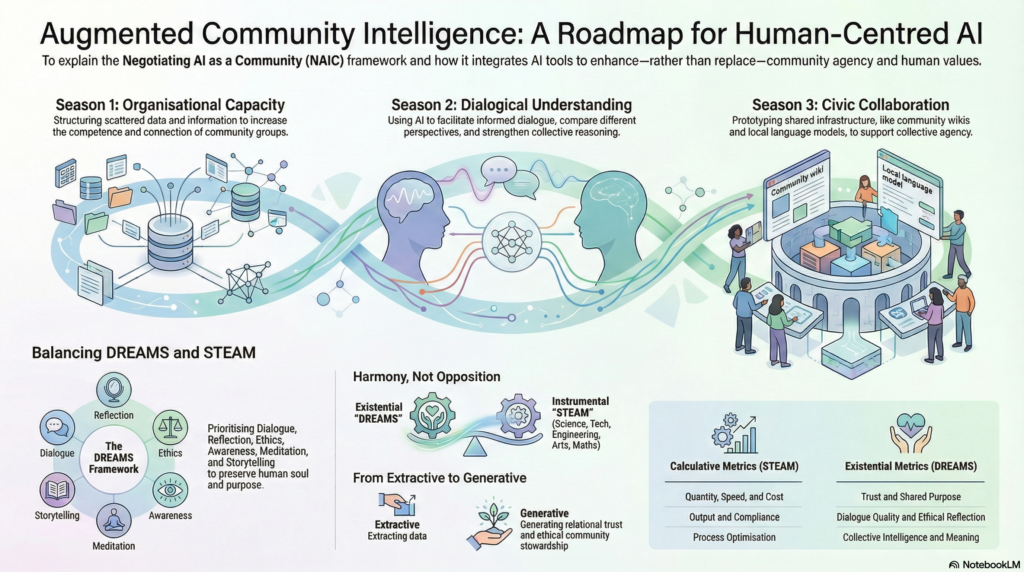
I suggested three further ‘seasons’ of workshops following the ‘pilot season’. Season One would focus on ‘Organisational Capacity’ – using AI to augment the knowledge management capability of community organisations (CommOrgs), Season Two on using AI to augment ‘Dialogical Understanding’, strengthening collective reasoning, while Season Three would be about augmenting ‘Civic Collaboration’ by co-creating and co-managing tools such as local LLMS, forums and local wikis.
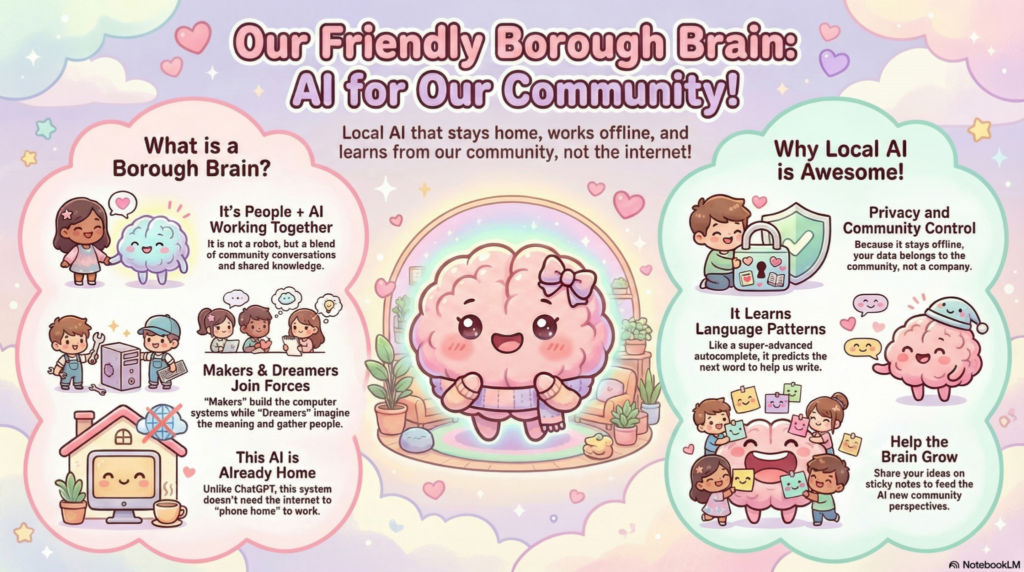
We discussed working with Kiran Patel’s Makers Club at the University of East London to explore the use of a local LLM for Newham CommOrgs. I used Notebook LM to translate the idea into a cute infographic titled ‘Our Friendly Borough Brain: AI for Our Community’. The premise was that a knowledge and communication resource owned by the local community could bring us together as a sort of ‘knowledge cooperative’.
I would like to explore that notion of a knowledge cooperative with partners in the Newham Citizen Science CIC. I believe that it would give us a role beyond the organisation of the annual citizen science fairs.
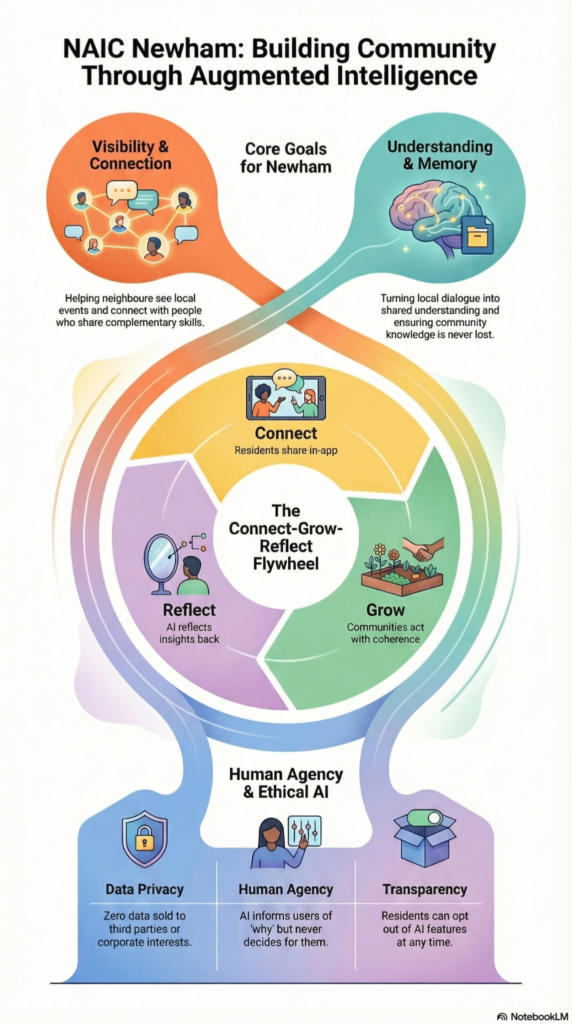
At the Fair Yommy Ojo shared ideas on how an app might be developed to link local people to each other and to the local LLM. Yommy suggested a system that would improve ‘visibility and connection’, helping people see what was happening locally and connecting people with complementary skills or interests. The system could also preserve and make accessible knowledge from the myriad local conversations that were happening online in various local social media groups.
Yommy also used a Notebook LM generated graphic for his presentation.
The third presentation on the Borough Brain idea at the Citizen Science Fair was by Lia Rees.
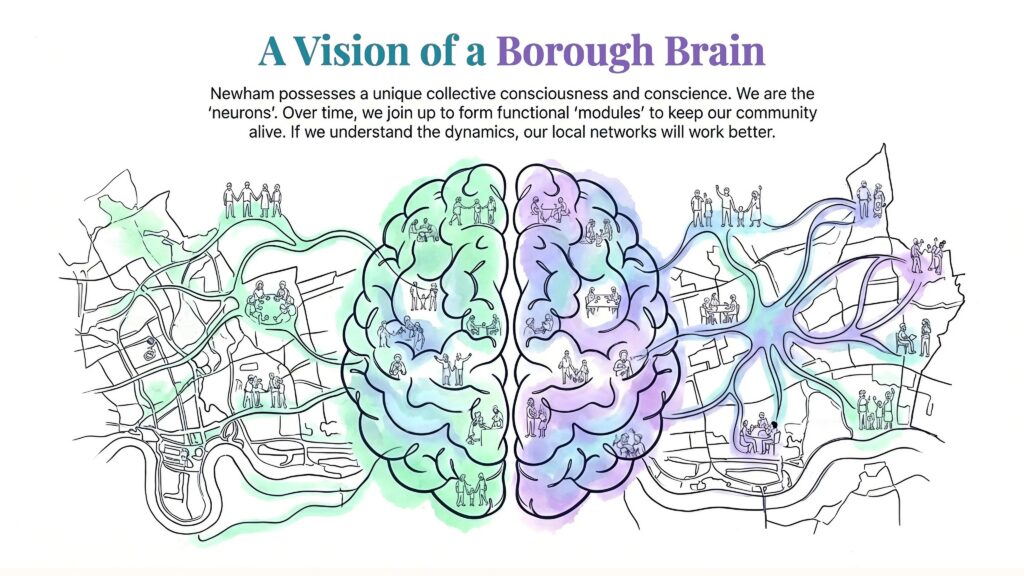
Whatever we call it, it resonates with me, because there are so many parallels with local history and how this borough naturally operates. You might say Newham has distributed intelligence. We can see ourselves as individual “neurons”, and over time we’ve joined up into “modules” to carry out the various functions of a community brain.”
Lia asserted that the ‘Borough Brain’ already exists and has existed for some time.
What resonates with me is the notion of ‘distributed intelligence’. We already have that in the Newham community, we need to recognise and strengthen that but we shouldn’t be going in the direction of substituting centralised intelligence, even locally centralised intelligence, for it. NAIC, perhaps through the Newham Citizen Science CIC could serve to strengthen that distributed intelligence across the community.
NAIC Beyond AI
The conversation around AI has changed. People are looking beyond the surface utility of AI and considering its political, economic and environmental impacts. There is concern about the power it gives to states and corporations, the further concentration of wealth and agency in a few hands and the profligate misuse of resources to build data centres that damage rather than contribute to human wellbeing.
The Pope’s encyclical resonates with this in its highlighting of Domination, Exclusion and Death as consequences of pursuing AI for purely instrumental rather than human existential objectives:
“The Church has long been working for nuclear disarmament, aware that every great technical power can affect people’s lives and so must be accompanied by adequate moral discernment and public control. Nuclear disarmament remains a service to peace and the dignity of the human family.
In a similar sense, artificial intelligence now demands to be “disarmed,” freed from logics that turn it into an instrument of domination, exclusion and death. Like nuclear energy, it must be at the service of all and of the common good.”
“Domination, Exclusion and Death”
I express this as Domination, Repression, Exclusion, Alienation and Death (DREAD) and suggest that the counter to this lies in Dialogue, Reflection, Ethics, Awareness, Meditation and Storytelling (DREAMS). Not in particular ‘doings’ but in different ways of thinking and being.
NAIC is a call for us to think together and work together as communities to ensure that AI and the other structures that should serve us actually do so.