This article is shared ahead of presentation at the Newham Citizen Science Fair (28 March 2026) as an invitation to dialogue — not as a finished position but as a proposed framework to test, question and refine together.
The Negotiating AI as a Community (NAIC) initiative explores how artificial intelligence can be reclaimed as a tool to expand human agency and collective intelligence rather than diminish it. Through a series of structured workshops, the project aims to transform scattered data into actionable knowledge that serves local organisational, dialogical, and civic needs. Central to this framework is the concept of “Augmented Community Intelligence,” which prioritises human connection and democratic reasoning over purely algorithmic decision-making. The author proposes a “counterpoint” to technical fields by introducing DREAMS, a set of human-centric values designed to ensure technology remains rooted in ethics and reflection. Ultimately, the text invites global and local collaboration to build a shared infrastructure where communities manage their own digital resources for the common good.
A Means Not An End
Negotiating AI as a Community (NAIC) approaches AI as a means, a tool —AI is neither an end in itself, nor, in itself, the end of the world. It is a means and a tool to achieve the ends, good or ill, wise or foolish, that we choose as a civilisation. NAIC is a proposition that we as members of a particular community think together about how we think about, use and manage a revolutionary technology for wise and good ends.
Organisational, Dialogical and Civic
The NAIC mission is simple:
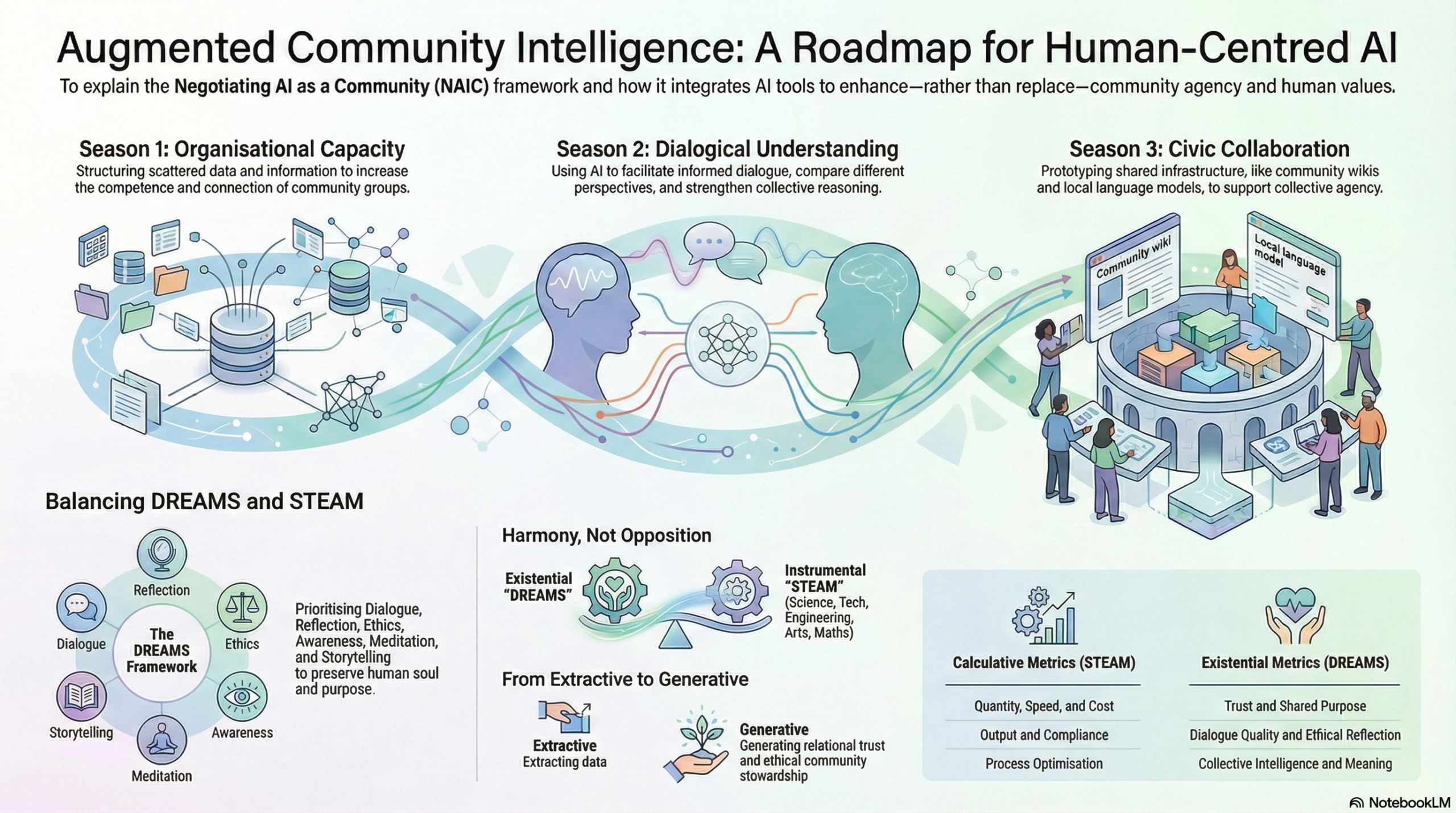
- To use AI as an organisational tool that increases the competence, connection, coherence and cognitive capacity of community and community groups by structuring complexity. To move data to information to knowledge. The organisational use of AI in the community is being explored as we work with community organisations — such as the Climate Emergency Centres network to structure information — including information from WhatsApp conversations, webinars and dense reports so that it is more accessible and more easily deployed.
‘To organise information better – so that we manage it instead of being managed by it.’ - To use AI as a dialogical tool that strengthens our ability to think clearly as individuals — and to think well together as communities. To move knowledge to understanding and right action. The dialogical use of AI includes using it to support democratic reasoning and decision making not only by accessing information but also by facilitating wider understanding through questioning that understanding, by presenting and comparing different perspectives and alternative understandings.
‘To understand our situation more accurately through informed and inclusive dialogue – so that we respond on the basis of evidence, reason and human value rather than algorithmic push.’ - To use AI as a civic tool that strengthens grassroots community capacity to recognise issues, deliberate intelligently, and act constructively — whether within existing systems of governance or by seeking to reform them where necessary.
‘To act together, responsibly and effectively — ensuring that human conscience, relationships and agency shape the systems that govern us.
NAIC is not about machines and algorithms. It is about asserting the value of people in the age of algorithms. It is about enhancing human capacity and agency through the wise and appropriate use of technology.
The Workshops
The NAIC project is an initiative of Netstorms Limited (a business identity) and Newham Mosaic (a community identity open to others to join).
Following discussion with others, principally Lia Rees, It began with a workshop series subtitled “Building a Borough Brain.” But the “brain” we are building is not a computer. The brain is us in dialogue as a community — augmented by AI tools, but fundamentally a network of humans, not of computers.
We are aiming for something I call ‘Augmented Community Intelligence’ (ACI) — a community that uses AI dialogically to enhance collaboration, learning, and collective decision-making.
NAIC: Building a Borough Brain is not a course. It explicitly presented as a series of workshops in which we explore the organisational, dialogical and civic uses of AI and through that exploration build a learning and change-effecting community network.
The NAIC workshops are divided into ‘Seasons’ and those ‘Seasons’ into ‘Sessions’.
The first Season consisting of five sessions was run from November 2025 to January 2026. It could be likened to an ‘alpha testing’ phase with the first cohort being part of the product development. The lesson I took from this first trial is that even though the exploration was valued and participants said that they learned a lot they would have appreciated more structure. We are reviewing this to get the balance right but the next time we run Season 1 it will look more structured while not losing the emphasis on exploration.
Season 1 – AI and the Community Actionist (Organisational)
“…to establish a shared understanding of how community actionists can practically use AI tools…”
The aim of this season is to establish an understanding of the relationship between ‘community actionists’ and AI tools. How these tools can be effective in supporting community actionists and organisations in managing information and strengthening communication, reach and engagement. This goes beyond ‘knowing the tools’ to using and assessing them in our practice.
The questions this season addresses are to do with the organisation of our work:
How can we make our knowledge assets more usable (videos, photographs, reports) in order to better reach and inform others?
How can we stop losing information in WhatsApp threads?
How can we turn scattered data into something actionable?
Season 2 – Reconnaissance, Recognition and Response. (Dialogical)
“…to collectively map where we are, who we are, and why and how we should act …”
The aim of this season is to gain a collective understanding of where we are as a community, what the challenges are, who we are and what are the values from which we act. To learn lessons from both the past and the present (Reconnaissance). To understand what the challenges – economic, social and environmental – are and how we can work together to respond to them (Recognition and Response).
The questions this season addresses are to do with dialogue about the contexts, values and purpose of our work:
How can we deepen understanding of our purpose?
How can we address different perspectives inside and outside of our group?
What is the relationship of premises, principles and people to process, practice and production in our work?
Season 3 – Resistance, Resilience and Renaissance (Civic)
“…to prototype and strengthen coherent community structures…”
To build coherent structures of collaboration — a symphony emerging from existing synergies — strengthening community capacity through coordination rather than control.
Stepping back, I realise that even at this distance from a formal ‘Season 3’, the structures are already beginning to form. Because I am writing about and developing the conceptual framework of NAIC, it might appear — even to myself — that this is a ‘one-man show’. It is not.
NAIC has been collaborative from the outset, even without formal committees, constitutions or contracts. Lia Rees has been central in shaping its direction. Early and consistent participants — notably Rose Russell, Des Blake, Shona Pollock and Halima Hamid — have become de facto co-developers through their engagement inside and outside the sessions.
The support of Kiran Patel and Jameela Webster at the Royal Docks Centre for Sustainability has gone well beyond providing classrooms. Collaboration with the Climate Emergency Centres network, liaison with UEL students on placement, and work with the Newham Citizen Science project — of which I am now a director — already model the kind of cross-project reinforcement that NAIC seeks to catalyse.
Synergy evolving into symphony.
If Season 1 focused on structuring information, and Season 2 on structuring dialogue and shared understanding, Season 3 focuses on structuring collaboration and collective agency.
In practical terms, Season 3 will prototype shared civic infrastructure. An initial example is the development of a community wiki — a shared, editable knowledge base to support collective memory, coordination and transparency. Beyond this, we are exploring, in collaboration with Kiran Patel and others, the possibility of a locally hosted language model that can assist in navigating and synthesising community knowledge. A demonstration of this direction may form part of the Citizen Science Fair.
The questions this season addresses are to do with the organisation of our collaboration and community:
How can we support each other’s initiatives more intentionally?
How can we build systems that support effective inter-group coordination?
How can we develop feedback and shared accountability mechanisms?
How can we ensure transparency and mutual trust across collaborations?
STEAM DREAMS
At the heart of the NAIC project is the notion of Dialogue as the foundation of human intelligence, both individual and collective. As someone arguably over fond of acronyms I came up with the acronym DREAMS — Dialogue, Reflection, Ethics, Awareness, Meditation and Storytelling, as a counterpoint to STEAM — Science, Technology, Engineering, Arts and Mathematics. I contrast these two framings as existential and instrumental, inward and outward or as the philosopher Martin Heidegger put it, meditative thinking and calculative thinking.
In highlighting the two contrasting perspectives, the existential and the instrumental, I don’t mean to preference one over the other. The existential without the instrumental is contemplation without enactment while the instrumental without the existential is production without meaning.
In music, counterpoint is not opposition, it is the interrelation of independent themes. Two melodies sounding at once, distinct but harmonically engaged. This is the engagement that NAIC seeks to facilitate. It is not about opposition to or adoption of new technologies ‘because they are there’, it is concerned with the harmonic engagement of AI and other technologies with human purpose, autonomy and wellbeing. Our argument is that DREAMS and STEAM are both essential for human flourishing.
It is purpose and people that DREAMS brings to STEAM, placing alongside ‘Performance Indicators’, complementary ‘Purpose Indicators’ and ‘People Indicators’.
The metrics vary according to sector but across sectors, institutional Performance Indicators overwhelmingly measure:
- Quantity
- Speed
- Cost
- Output
- Compliance
- Growth
They are rooted in calculative thinking, optimising processes, but do not easily capture:
- Trust
- Meaning
- Shared purpose
- Dialogue quality
- Ethical reflection
- Collective intelligence
These are often rhetorically affirmed but structurally undermeasured in corporate or institutional goals. They are, however, central community and human goals and DREAMS brings them to the table, as explicit measures of relational and ethical health, so that what we deliver is not simply performative but is purposive and people oriented.
DREAMS is not just an acronym or mnemonic. It describes a process.
- Dialogue that is honest, inclusive and informed, courageous but not combative.
- Reflection that introduces pause, self-questioning and guards against groupthink.
- Ethics that align production and processes with people, purposes and principles.
- Awareness that includes the impacts of decisions on people and on the environment.
- Meditation as the carving of space for relationship with self, others and the environment, not as an optional extra but as a self and community empowering discipline.
- Storytelling is the articulation of experience that allows us to integrate it personally and as communities.
DREAMS are existential. They are of the soul of humanity and are what we need to consciously bring to the machine. One teacher asked, “What does it profit us if we gain the world and lose our soul?”
Technology amplifies capability. Without existential grounding, amplification accelerates alienation.
AI and institutional measurement systems become extractive when they amplify calculative outputs without renewing relational trust and ethical agency.
DREAMS asserts the value of people in the age of the machine and algorithms. The NAIC invitation is an invitation to take DREAMS seriously because that is what preserves our humanity.
But NAIC is not DREAMS alone. It is the harmonic engagement of DREAMS and STEAM for human and community purpose and wellbeing. It is intended to promote and support the socially ‘generative’ rather than socially ‘extractive’ use of AI and technology and is congruent with sustainability thinking about generative vs extractive economies.
Collaboration, Coherence and Community
To reiterate, NAIC is not a course and not a consortium. It is an evolving process of co-development, collaboration and community-building. Workshops are being planned, joint projects are emerging, assets are being developed and dialogue continues — in person and online — as the network grows organically. So far we have spoken about a community of learning and dialogue but the intention beyond that is a creative community that owns and manages its own resources including a community wiki and local LLMs under cooperative and open source principles.
We are not seeking funding to manufacture a programme; we are inviting ideas, collaboration and critical engagement to build an inclusive infrastructure for coherent, creative and DREAMS-led community use and stewardship of AI and other technologies. Why does this matter? And why does this matter now? What ‘problem’ does NAIC solve? NAIC does not claim to solve our environmental, social or technological crises directly. But it addresses the conditions that make those crises harder to respond to, it addresses issues such as our sense of, and the actuality of, a loss of agency, meaning and human connection within our lives and communities. Its product is an ‘overstanding’ of the issues not just an ‘understanding’. I borrow the Rastafarian word ‘overstanding’ to suggest not only comprehension of the issues but the intention and strategy to address them.
There are WhatsApp groups and mailing lists for participants and partners, but for now the Newham Mosaic website remains the central point of information. Please register, leave your comments, and join the conversation.
While NAIC is rooted in Newham, the dialogue is not geographically bounded. If you are involved in related work elsewhere, let us exchange ideas and learn from one another. Augmented Community Intelligence is not an idea owned by any individual, organisation or locality — and it will not be built in isolation.
For that reason, this reflection is being shared on Medium and other transnational platforms, as well as through our local forums, websites and social media groups. The intention is not expansion for its own sake, but connection — to contribute to and learn from parallel efforts wherever they are emerging.
The challenges we face are shared; so too must be the intelligence with which we respond to them.